
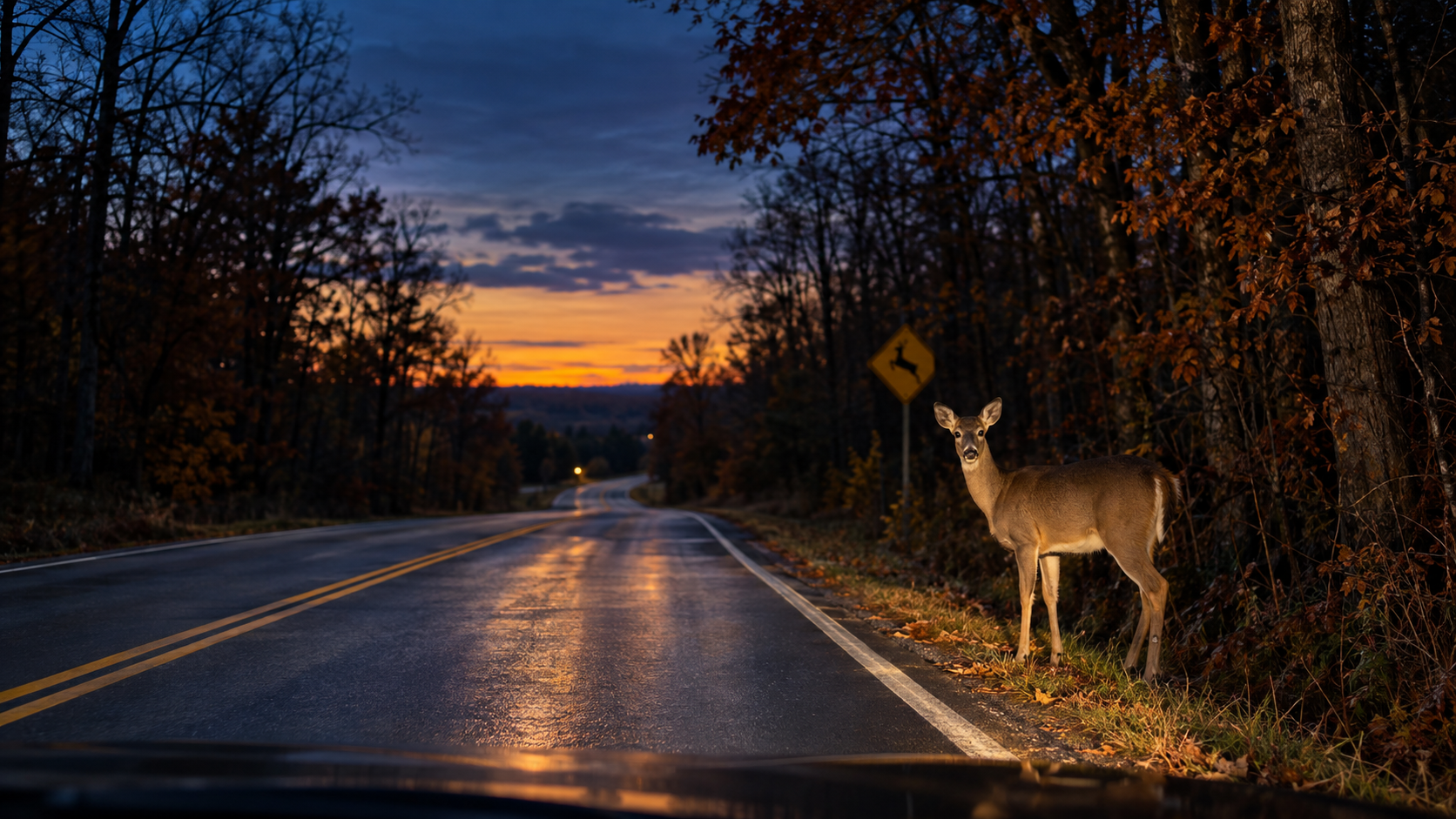
Hitting a deer in Virginia is far more likely right now than at any other time of year. Between one-half and two-thirds of all deer-vehicle collisions in the Commonwealth happen in October, November, and December, and the reason is simple biology: it is breeding season, deer are moving, and they are moving at exactly the hours you are driving home.
Most drivers have never thought about what to do in the two seconds before that happens. The instinct almost everyone has is the one that gets people hurt, and in Virginia it can also cost you your insurance claim.
Quick Answer: What to Do If You Hit a Deer in Virginia
- Brake, do not swerve. Stay in your lane. Swerving causes the more serious crashes and can shift fault onto you under Virginia’s contributory negligence rule.
- Get to safety. Pull onto the shoulder, turn on your hazards, and call 911 if anyone is hurt or the road is blocked.
- Report it. If the deer was killed, Virginia Code § 29.1-539 requires you to report it immediately to a conservation police officer or local law enforcement. In Fairfax County, call the police non-emergency line at 703-691-2131.
- Document the scene. Photograph your vehicle, the roadway, the lighting, and any deer crossing signs.
- Call your insurer. Hitting a deer is usually a comprehensive claim, not a collision claim, and is generally treated as not-at-fault.
Why October Through December Is the Danger Zone
Fairfax County puts it plainly: roughly half or more of all deer-vehicle collisions occur across those three months. The rut sends deer across roads they normally avoid, and it pushes them into the open during the two windows when traffic is heaviest.
Deer are most active from pre-dawn through mid-morning, and again from dusk into early evening. Those are commuting hours. When the clocks fall back in early November, the evening rush moves into full darkness while deer activity is still at its annual peak. That overlap is what makes late autumn different from the rest of the year.
One more thing worth burning into memory: if a deer crosses in front of you, more are probably coming. They travel in groups. The second and third animal are the ones that hit the side of the car.
Hitting a Deer in Virginia Is Usually the Safer Outcome
This sounds wrong until you look at the numbers. According to the Virginia Department of Wildlife Resources, fewer than two percent of vehicular fatalities and injuries in Virginia involve a deer collision. A modern vehicle striking a deer at a moderate speed is, in the large majority of cases, survivable and often walk-away.
The national numbers point the same way. State Farm estimates there were more than 1.6 million animal-vehicle collision claims in the United States between July 2025 and June 2026, with deer by far the most frequently struck animal, and puts the average driver’s odds of an animal collision at 1 in 145 per year. Neighboring West Virginia has had the highest odds in the country for more than a decade, at 1 in 46. The Insurance Institute for Highway Safety counted 210 deaths in crashes involving animals in 2024, and many of the most serious of those crashes involve a vehicle leaving its lane.
What is far more dangerous is what people do to avoid the deer. Swerving at highway speed puts you into oncoming traffic, into a guardrail, into a tree, or into a rollover. Those are the crashes that produce serious injuries and fatalities. The deer is rarely the thing that hurts you.
Never Swerve, and Why It Is a Legal Decision Too
Virginia DWR’s guidance is unambiguous. Never swerve. Brake firmly, stay in your lane, keep both hands on the wheel, and let the collision happen if it is going to happen.
There is a second reason that advice matters here specifically, and it has nothing to do with physics. Virginia is one of a small handful of states that still applies pure contributory negligence. If you are found even one percent at fault for a crash, you can be barred from recovering anything at all.
Follow that through. Hitting a deer in Virginia while staying in your own lane is a single-vehicle animal strike. Swerve across the center line and strike another car, and you are now the driver who left their lane. You may have created a liability claim against yourself, and if you were injured in that same crash, your own recovery can be wiped out by the swerve. Our car accident attorneys in Fairfax see this pattern every autumn.
What Your Insurance Actually Covers
This is where the swerve decision shows up on paper.
- You hit the deer. That is an animal strike, and it falls under comprehensive coverage. It is generally treated as not-at-fault, and it does not require anyone else to be liable.
- You swerve and hit something else. That is a collision, and it runs through collision coverage or through liability if you struck another vehicle. Fault is now in play.
- You carry liability only. Neither the deer damage nor the swerve damage to your own vehicle is covered. Liability coverage pays other people, not you.
Comprehensive is optional in Virginia. Plenty of drivers carrying older vehicles have dropped it without realizing what that means in October. It is worth ten minutes with your declarations page before the season gets deeper.
What Virginia Law Requires After You Hit a Deer
Virginia treats this differently from an ordinary fender bender. If you hit and kill a deer, Virginia Code § 29.1-539 requires you to report the accident immediately to a Conservation Police Officer or other law enforcement officer in the county or city where it happened.
There is also a provision most drivers have never heard of: you may keep the deer. The same statute lets a driver claim a deer, bear, turkey, or elk struck by a motor vehicle at any time of year, as if it had been taken during hunting season. After you report the collision, the officer views the animal, awards it to you, and gives you a call for service number or report number. Keep that number. It is your proof the animal was lawfully claimed, so this is not something to skip and sort out later. If you do not want the deer, the officer may award it to someone else who does.
Beyond the wildlife rules, treat it like any crash. Move to the shoulder if the vehicle is drivable, put on hazards, stay in the car if you are on a fast road, photograph the vehicle and the scene, and do not approach an injured animal. A wounded deer can seriously hurt someone.
Who to Call in Fairfax County
Fairfax County asks residents to report a collision involving an injured or deceased deer to the Fairfax County Police Department non-emergency line at 703-691-2131.
For removal of an animal from the roadway, VDOT takes requests through its online work request form at my.vdot.virginia.gov or by phone at 1-800-FOR-ROAD.
If anyone is injured, call 911 first and let the wildlife reporting follow.
When Hitting a Deer Becomes Someone Else’s Fault
Not every deer crash is a solo event, and this is the part that turns a wildlife story into a legal one.
If the driver ahead of you swerves to miss a deer and strikes your vehicle, that is an ordinary motor vehicle collision. The deer is the reason it happened, but the other driver’s decision to leave their lane is what caused your damage. The same is true if a driver brakes violently for an animal and you are struck from behind by the car behind you.
These cases get complicated quickly. Insurers may argue the deer was an unavoidable emergency, and in a contributory negligence state the other side will look hard for any reason to place a share of fault on you. Whether the at-fault driver carries enough coverage matters too, which is where uninsured and underinsured motorist coverage can become the difference between a recovery and nothing.
If you were hurt in a crash that started with an animal in the road, the sooner the scene is documented, the better. Photograph the roadway, the sight lines, the lighting, and any deer crossing signage before it gets dark or the vehicles are moved.
Drive the Season, Not the Speed Limit
The practical version of all of this is short. Slow down at dusk and dawn on wooded roads. Use high beams when there is no oncoming traffic. Scan the shoulders, not just the lane. Assume a second deer. Wear your seat belt, because it is the single thing that most reliably turns a serious autumn crash into a survivable one. And if it comes down to it, brake hard and stay in your lane.
If you or a family member has been injured in a crash anywhere in Northern Virginia, our Fairfax injury team can help you sort out what happened and who is responsible. Hilton & Somer, LLC has represented Virginia, DC, and Maryland families since 1965. Call (703) 560-0700 for a free consultation or request a case evaluation online. All cases are handled on contingency, which means you pay no attorney fees unless we are successful.
Frequently Asked Questions About Hitting a Deer in Virginia
Is hitting a deer an at-fault accident in Virginia?
Generally, no. Striking a deer is an animal collision that is usually handled under comprehensive coverage and treated as not-at-fault. If you swerve and hit another vehicle, a guardrail, or a tree instead, the claim typically becomes a collision or liability claim, and fault can be assigned to you.
Do I have to report hitting a deer in Virginia?
Yes, if the deer was killed. Virginia Code § 29.1-539 requires the driver to immediately report the collision to a conservation police officer or other law enforcement officer in the county or city where it happened. In Fairfax County, call the police non-emergency line at 703-691-2131. Call 911 first if anyone is injured or the animal is blocking traffic.
Can I keep a deer I hit with my car in Virginia?
Yes. Once you report the collision, the responding officer views the animal and, if satisfied it was killed by a vehicle, awards it to you along with a call for service number or report number. That number documents your lawful possession.
Does car insurance cover hitting a deer in Virginia?
Only if you carry comprehensive coverage, which is optional in Virginia. A liability only policy pays for damage you cause to other people, not for damage to your own vehicle from a deer strike.
When are deer collisions most likely in Virginia?
October through December, during the breeding season known as the rut. Between one-half and two-thirds of Virginia’s deer-vehicle collisions happen in those three months, most often around dawn and dusk.
Can I recover compensation if another driver swerved to avoid a deer and hit me?
Often, yes. A driver who leaves their lane to avoid an animal and strikes your vehicle may be responsible for your injuries. Because Virginia follows pure contributory negligence, the other driver’s insurer may try to place even a small share of fault on you, so it is worth speaking with a Fairfax car accident lawyer before giving a recorded statement.
Also worth a read this season: our guide to Virginia’s new vulnerable road user safety zones.
References
- Virginia Department of Wildlife Resources. “Drivers: Stay Alert, Deer are on the Move.” dwr.virginia.gov
- Fairfax County, Virginia. “Deer-Vehicle Collisions.” fairfaxcounty.gov
- Code of Virginia. “§ 29.1-539. Claiming deer, bear, turkey, or elk struck by motor vehicle.” law.lis.virginia.gov
- State Farm. “20 Years of Animal Collision Data, One Goal: Safer Roads Ahead.” newsroom.statefarm.com
